

In 2026, the phrase “getting an appointment” has become a universal shorthand for administrative friction. For patients, the experience is frequently defined by fragmented, disconnected systems, the exhausting need to repeat their medical history to multiple intake staff, and the frustrating reality of “phone tree” purgatory. For providers, the internal reality is equally strained—clinician burnout is at an all-time high, driven by the relentless burden of manual charting, appointment scheduling bottlenecks, and the sheer inefficiency of legacy digital stacks that were never built for the velocity of modern medicine. As healthcare SaaS platforms continue to evolve, they are moving away from legacy monolithic structures to solve this specific crisis. This is the “Care Access Crisis,” an infrastructure failure that healthcare SaaS PHIPA compliant engineers are uniquely positioned to solve.
The Evolution of the Patient Experience
Historically, “digital health” was a thin web layer mapped atop a legacy core. Patients entered data into static PDFs or web-based forms that were then manually processed, transcribed, and filed by front-desk staff. Today, this is no longer sufficient. Patients have become “digital consumers.” They expect a standard of care that matches the convenience they experience in every other aspect of their daily lives. They demand transparent, real-time scheduling, instant updates, and care paths that are tailored to their personal schedules. When a system forces a patient to wait days for a basic appointment confirmation, trust erodes immediately. In 2026, providers that fail to modernize their AI web design are being judged not just on clinical outcomes, but on the perceived efficiency of their digital ecosystem.
Why Healthcare SaaS is the Future of Digital Health
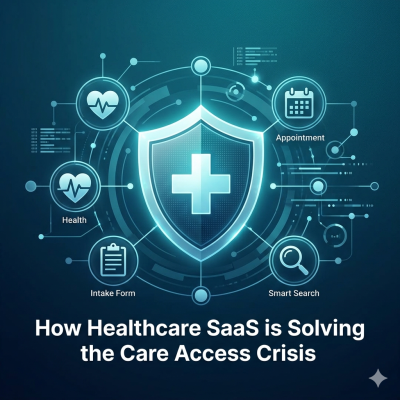
Engineering Trust: Secure Digital Infrastructure for Healthcare SaaS.
AI as the Intelligent Sentry
The shift from static intake to intelligent triage is one of the most significant advancements in modern healthcare software. Modern platforms are now deploying AI as a “digital nurse,” capable of asking adaptive, context-aware questions based on a patient’s specific symptoms, history, and current medication profile. This smart triage does more than replace a paper form; it actively routes patients to the appropriate level of care, whether that is a virtual visit, an urgent in-person consultation, or a follow-up with a specialist. By identifying high-risk signals early and routing low-acuity issues to more efficient care channels, healthcare SaaS platforms are finally reducing the crushing pressure on front-desk staff. The integration of AI Smart Search is revolutionizing how clinics manage high-volume patient data, allowing the system to surface relevant clinical notes in seconds.
Operational Efficiency: The Clinician’s Perspective
For the provider, the goal is simple: reduce the “pajama-time” charting that keeps clinicians logged into systems long after the clinic has closed. The integration of ambient AI scribes and automated documentation tools is moving from a luxury to a baseline requirement. When SaaS tools handle the administrative load—such as prior authorizations, appointment coding, and follow-up triggers—the clinician is finally freed to focus on the patient. This isn’t just about speed; it is about reclaiming the human connection. Clinicians who can spend their appointment listening, looking at the patient, and building rapport—rather than typing into a cumbersome interface—are more likely to stay engaged, directly addressing the root cause of systemic burnout.
Redefining the Digital Architecture
True disruption in healthcare SaaS will not come from “feature-adding” but from “platformization.” The leaders in 2026 are those who treat compliance, data sovereignty, and interoperability as fundamental design constraints rather than post-implementation hurdles. In a landscape where data security mandates are tightening, successful platforms are building sustainable advantages by redesigning workflows around the people who actually use them. Whether you are refining an existing digital marketing strategy to better communicate your platform’s value, or architecting a new modular system, the architecture must be built for trust. By embracing cloud-native, modular architectures, providers are creating systems that are adaptable to sudden fluctuations in demand. They are building platforms that can communicate with disparate hospital information systems without requiring massive overhauls. This modularity ensures that care can remain consistent and accessible regardless of broader system strain or technical limitations.
As we move forward, the “Digital Front Door” will continue to evolve, moving toward predictive care rather than reactive processing. The promise of digital health is not about replacing the human element with an app; it is about using technology to strip away the administrative friction that prevents humans from connecting. For healthcare organizations and SaaS developers, the mandate is clear: build systems that are coherent, transparent, and, above all, designed to earn public trust through results that patients can feel.
The Anatomy of Technical Debt in Healthcare
For most healthcare organizations, the primary obstacle to innovation is not a lack of vision, but the crushing weight of technical debt. When a system is built on “spaghetti code”—a complex web of interdependent, poorly documented legacy scripts—every new update carries the risk of a system-wide crash. To remain competitive, firms must ensure that their healthcare SaaS architecture is modular enough to scale as patient volume grows. Modern healthcare SaaS PHIPA compliant engineers approach this challenge by architecting “decoupled” systems. By separating the user interface from the backend business logic and database layers, providers can upgrade their patient-facing portals without requiring a total overhaul of their core medical records systems.
This decoupling is essential for security. By using API-first design principles, you ensure that data flows are encrypted and authorized at every single hand-off point. This is the cornerstone of PHIPA compliance; it ensures that even if one component of the software architecture is compromised, the broader patient database remains shielded behind redundant validation layers.
Data Integrity as a Competitive Advantage
We often talk about “AI” as a magic box that delivers answers, but in healthcare, AI is only as good as the data it is fed. If your legacy intake forms are missing fields, or if your database uses outdated encoding, your AI models will generate “hallucinations” or, worse, clinical errors. The future of healthcare SaaS lies in data hygiene. High-performance software now includes real-time data validation engines that catch errors the moment a patient types their information.
This goes beyond simple form checks. It involves semantic data mapping—ensuring that a “blood pressure” reading captured on a mobile app is instantly and accurately interpreted by the EHR (Electronic Health Record) system, regardless of the different formats the two systems might prefer. Building this level of interoperability requires a shift from “flat file” databases to graph-based data structures that can understand the relationship between a patient’s historical lab results, current vitals, and prescribed medication plans.
The Rise of Ambient Intelligence
We touched on AI scribes, but let’s examine the architectural requirements for “Ambient Intelligence.” To truly remove the clinician from the screen, the software must be capable of processing multi-modal input. This means the system doesn’t just listen to audio; it correlates that audio with clinical guidelines and existing patient history in real-time. This is where 416 web design evolves into “Intelligent System Design.” The software doesn’t just record; it suggests.
When a physician discusses a treatment plan, the system should be able to cross-reference that plan against current insurance requirements and drug interaction databases in the background, surfacing a “pre-approval” flag before the patient even leaves the exam room. This is the difference between a “tool” and an “assistant.” For SaaS developers, this requires a move toward edge computing—performing the heavy processing of the audio data locally rather than routing it through high-latency cloud servers, ensuring the system remains snappy and responsive even in clinics with sub-optimal internet connectivity.
Compliance by Design
One of the biggest pitfalls for new health-tech entrants is treating security as a “bolt-on” feature. In 2026, security must be an immutable property of the code itself. We advocate for “Immutable Infrastructure” practices, where the environment in which your software runs is version-controlled and hardened against common attack vectors. This means using automated security scanning in your deployment pipeline to ensure no vulnerabilities reach production.
Furthermore, we must talk about the user experience of privacy. A digital marketing strategy for a healthcare brand is fundamentally different because it must lead with trust. Every time a patient is asked to share data, the interface should provide clear, accessible explanations of why that data is needed and who has access to it. This transparency is not just good PR; it is the fundamental requirement for building long-term, high-LTV (Lifetime Value) patient relationships.
The Road Ahead: Predictive Orchestration
The “Digital Front Door” is just the beginning. The next frontier in healthcare SaaS is predictive orchestration—the ability to identify a health decline before the patient even feels the symptoms. Successful deployments of modern healthcare SaaS show that when infrastructure is built correctly, patient retention increases by over 20%. By analyzing longitudinal data patterns, these systems will soon be able to trigger automated follow-ups for patients who show signs of non-adherence to their treatment plans. This moves healthcare from being reactive to being proactive, shifting the paradigm of cost-saving from “reducing administrative work” to “improving outcomes and reducing hospital readmissions.”
For SaaS leaders, the final takeaway is this: Technology is not the solution—it is the facilitator. The solution is the human-to-human connection. Every line of code, every database schema, and every interface choice you make should be measured against one metric: “Does this make it easier for a patient to be heard, and for a clinician to be present?” If the answer is yes, you are building the right infrastructure.